Avoiding direct sight of the creatures
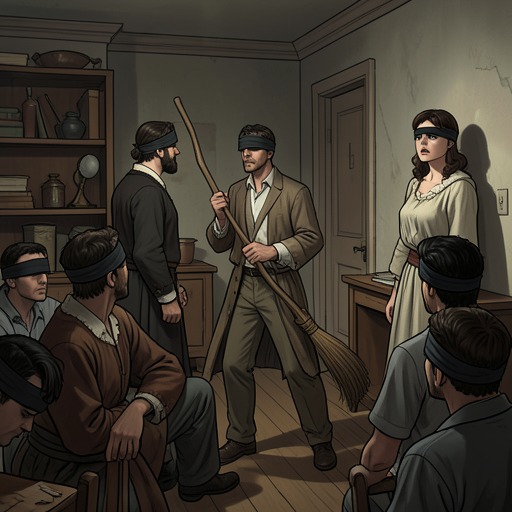
Bird BoxAvoiding direct sight of the creatures is the rule on which Malorie and her children’s survival depends. In a world where an uncovered look can bring on madness, sight is not knowledge but exposure: windows are sealed, outdoor journeys are made blindfolded, and even the children’s beds are fitted with protective covers. The rule preserves life by restricting vision, while Malorie’s increasingly rigorous training makes that protection inseparable from fear, discipline, and the children’s lost access to an ordinary childhood.
The rule and its domestic defenses
At the house, the prohibition is built into the architecture of daily life. Cardboard and wood cover the windows, and the children sleep in a dark bedroom whose single window is further blocked by blankets. Black domes of cloth, held up by chicken wire salvaged from a garden fence, shield them in bed—not from something looking in, but from what they might see if their eyes were open. When Malorie prepares to take them outside, she loosens the wire fastened to the floor and brings out their blindfolds.
The children have never seen the world beyond the house, not even through its windows. Malorie has not looked outside for more than four years. When she tells them that neither may remove a blindfold under any circumstances, she states the rule as an absolute and attaches a threat of punishment to disobedience. The severity reflects the stakes: she warns that the world beyond the house can hurt them and her if they do not listen.
Protection does not mean that the house has become a place of ordinary safety. It has no running water, and wires connected to amplifiers alert the household to sounds outside. The children lack conventional toys; instead, they play with small figures whittled from pieces of a wooden chair. The covered windows and the blindfolds are parts of a wider survival arrangement, one that confines movement and substitutes vigilance for the freedoms the old household once offered.
Training sight out of daily life
For Malorie, the rule is not only something the children must obey on a dangerous excursion. She trains them from infancy to keep their eyes closed. As they wake in their chicken-wire beds, she watches with a flyswatter and strikes an arm when a baby opens its eyes; when the child keeps them shut, she closes them gently with her fingers and rewards the behavior by nursing. Protection is taught through a deliberately stark pattern of punishment and reward.
At three, the children are made to fetch water from the well by touch and sound. Malorie ties a rope around her waist and the other end around the Boy, then sends him along the path to feel his way with his toes. She listens as he struggles to raise the bucket and carry it back. If it falls, she makes him go out and try again. The Girl objects that the ground is too bumpy and seems to her as if people live beneath the grass; Malorie withholds food until she agrees to do the task. The rule thus governs not just whether the children see, but how their bodies learn to move through a world they cannot inspect.
She also tests their ability to locate people by sound. When they are toddlers, she places them at opposite ends of the living room, roams across the carpet, and asks where she is and where she has been. She yells when they answer incorrectly. They are soon rarely wrong, and then never wrong at all. These exercises make hearing a practical alternative to vision, but their success has a cost: Malorie recognizes that the training has made the children intensely obedient. Their competence in the dark is also evidence of how completely fear has shaped their behavior.
The rule beyond the house
Leaving home extends the prohibition into a route that Malorie cannot see and cannot fully control. Before taking the children toward the river, she tells them to hold hands on the path to the well and through the clearing behind the house. Because the path to the river is overgrown, she prepares them for the possibility that they will have to let go briefly; if they do, they must hold on to her coat or to each other. Blindfolded travel depends on procedure, touch, and listening rather than a view of the way ahead.
On the river, the same restriction turns every obstruction into an occasion for imagined danger. The rowboat repeatedly strikes the banks and gets stuck. While it is motionless, Malorie imagines unseen hands reaching for the children’s blindfolds, fingers rising from the water and mud. The children do not scream or complain. When the boat is freed, the Boy stands to push against a mossy trunk and Malorie resumes paddling. She hears birds, moving animals, and fish splashing, but none of these sounds gives her sight of what surrounds them. The question of how far a person can hear becomes a practical measure of what their survival method can offer—and what it cannot.
The prohibition also governs how Malorie responds to a stranger on the river. He says he has travelled with his eyes open and urges her to abandon the blindfold, presenting the view as something she has forgotten. Malorie refuses: “We are keeping our blindfolds on,” she says, and tells him to leave them alone. His confidence does not alter the rule. For her, the existence of an apparently ordinary person who claims to look without harm is not enough to make the risk acceptable.
The rule’s human cost
The discipline that keeps the children protected also places severe demands on Malorie’s body and judgment. She has feared injury for years because the children depend on her, recalling falls down cellar stairs, a head struck against a rock while carrying a bucket, a possible broken wrist, a chipped tooth, and bruised legs. During the river journey, her shoulder wound worsens, and fatigue and dizziness threaten the strength she needs to row. A blindfolded mother cannot simply stop and see what has happened or easily obtain help; the rule’s protection makes practical emergencies harder to assess and manage.
The same tension appears before the children are born. When Don argues that a child’s eyes would be safer if the child were blinded, Malorie understands the terrible logic of removing the danger by removing the capacity for sight. The thought opens up possibilities she knows no one from the old world would be prepared for, and it never entirely leaves her mind. Her understanding does not make the proposal harmless: it reveals how the rule can turn care into a question of what a parent might do to prevent a child from seeing.
At Tucker, Malorie encounters a community with a more extreme history of protection. Rick explains that a creature once entered the house while residents were out hunting. A mother became violently irrational and killed four children; the community spent months recovering and rebuilding, then vowed not to take that risk again. Its members blinded themselves with forks, kitchen knives, or their fingers, regarding blindness as absolute protection. Later, after fortifying the place, they eased that burden and had experienced no security lapses. Seeing Constance without scars, Malorie contrasts this collective history with George’s failed video experiments and remembers how close she came to blinding her own children. The rule is therefore neither a simple universal command nor an unchanged practice: it is a protective response whose human cost communities debate and revise as their circumstances change.
A protection that shapes the future
Avoiding direct sight of the creatures operates at once as a safety rule, a household system, and a form of education. It determines how the windows are covered, how the children sleep, how water is gathered, how the family travels, and what counts as reliable knowledge. Sound, touch, repetition, and obedience become substitutes for sight; the children’s remarkable ability to listen is inseparable from the frightening strictness required to teach it.
The rule also makes the prospect of seeing again uncertain rather than automatically liberating. Malorie recognizes that reaching a new place could mean the children encounter things they have never seen, but that possibility does not dissolve the years of fear or erase the risks that formed their lives. The rule’s significance lies in this double consequence: it allows a family to endure the unseen threat, yet makes every act of protection a negotiation between keeping sight away and deciding what kind of life can be lived without it.